
NVIDIA Partnership Brings Physical AI to Silicon Valley's Biggest Stage

When Jensen Huang took the stage at GTC 2026 last week, attendees didn’t just watch presentations—they experienced the next wave of physical AI firsthand. LiveX AI deployed interactive AI concierges across the San Jose Convention Center, delivering one of the largest real-world demonstrations of embodied AI at a major tech conference.
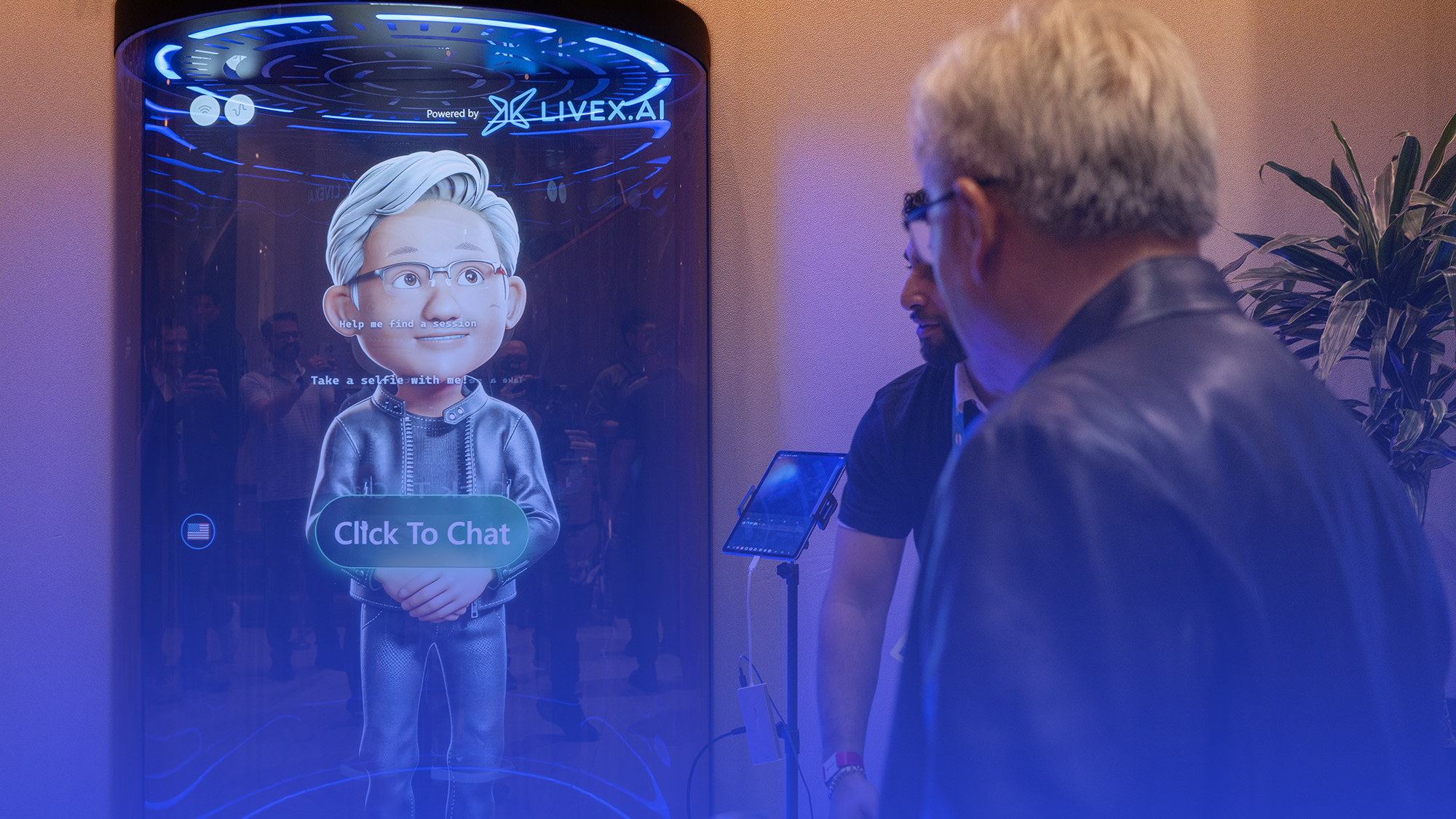
Among the highlights: Toy Jensen, or TJ. The holographic AI agent, named after NVIDIA’s CEO, became a fixture across the show floor. Eighteen avatars stood inside transparent vessels, answering attendee questions about the conference, physical AI, accelerated computing, and AI agents. TJ also became a viral moment on the floor, posing for photos—including one with Huang himself alongside his holographic counterpart.
The deployment was part of a strategic partnership with NVIDIA and included custom installations for Supermicro and Google—two of GTC’s premier sponsors. It marked a clear inflection point: physical AI operating live, at scale, in front of tens of thousands of enterprise decision-makers.
.jpg)
GTC 2026 emerged as ground zero for the “physical AI” movement. AI systems operating in the real world, not just in the cloud. NVIDIA’s positioning of physical AI as the next frontier was reinforced on the ground, with LiveX AI’s deployment translating that vision into a working, large-scale system.
The LiveX AI hologram kiosks were fully conversational, multilingual, and capable of real-time responses powered by large language models. Built on LiveX.ai’s agentic platform using NVIDIA hardware and software, including Nemotron models and NIM microservices. These systems demonstrated what happens when accelerated computing meets real-world customer interaction.
Unlike traditional kiosks with static touchscreens or pre-recorded content, these AI concierges:
At the Supermicro booth, the hologram acted as a product specialist, guiding visitors through server configurations and GPU infrastructure. At the Google Cloud booth, it surfaced developer tools, AI services, and case studies, trained directly on relevant documentation.
GTC is not just a launch platform. It is a validation stage. The conference brings together CTOs, infrastructure leaders, and AI researchers from across enterprise, startups, and government. A successful deployment here signals readiness.
The LiveX AI rollout demonstrated that physical AI can operate reliably under real-world conditions: high traffic, multilingual interactions, and technically demanding queries. Over four days, the kiosks handled large-scale interaction volumes, stress-testing performance in front of one of the most sophisticated audiences in the industry.
This directly addresses a key barrier in the market. Enterprise buyers do not lack awareness. They lack proof. GTC provided that proof.
.jpg)
Physical AI is increasingly competitive. Companies like Proto Hologram, ARHT Media, and HoloConnect are expanding into events and enterprise deployments.
LiveX AI’s differentiation was clear in execution:
Real-time conversational AI
Not pre-recorded loops or menu trees. Responses were generated dynamically using LLMs, enabling context-aware interaction.
Rapid customization
Domain-specific personas for Supermicro and Google were built within days, not months, with distinct knowledge bases and brand alignment.
Seamless multilingual capability
Users switched languages mid-conversation without friction, supporting global enterprise use cases.
%20(1).jpg)
GTC 2026 demonstrated a clear pattern: physical AI performs best in high-traffic, high-stakes environments.
The LiveX AI deployment showed that hologram kiosks can:
For industries such as retail, hospitality, and healthcare, the implication is direct. Physical AI is not a novelty layer. It is operational infrastructure.
LiveX AI’s presence at GTC 2026 served as a live blueprint for enterprise deployment of physical AI. The shift is underway: from screen-based AI to spatial, embodied systems. The companies that succeed will be those that deploy quickly, adapt to context, and operate reliably in real-world conditions.
For those who attended GTC, the takeaway was immediate and tangible. The future of customer interaction is no longer abstract. It is physical, conversational, multilingual—and already deployed at scale.
“This is really good… I just got a dream and it happens.”
— Jensen Huang.