.jpg)

LiveX AI at Nvidia GTC

LiveX AI's GTC deployment of 20 holograms running for three days without failure proves that physical AI works as distributed enterprise infrastructure, not as a one-off campaign activation.
It also proves LiveX is the only vendor with a stack battle-tested enough to deliver it.
Audiences at GTC were captivated by the site of 18 interactive Toy Jensen holograms across the GTC floor in March, 2026.
Along with additional units at the Google Cloud and SuperMicro booth, every single device worked flawlessly. For the team at LiveX, perfect performance is the standard. But the reality across the industry is quite different.
Most Hologram demos look great for ninety seconds in a controlled environment and fall apart the moment a real crowd shows up. Speech recognition collapses in the noise. Latency drifts past the point where conversation feels natural. The device locks up after fifty interactions and someone has to reboot it.
But ironing out those details and delivering a first-class experience when it counts is exactly what motivates our team, which is exactly why Jensen Huang’s office was confident that LiveX was the company to pull this off.
LiveX deployments always start with a thorough site analysis, and from the jump, our team knew it would be a tough environment to deploy in. The floor is loud. Attention windows are short. Attendees are walking from session to session with somewhere else to be. And with a huge crowd that skews technical, we had to wow users who could quickly tell whether they were talking to a real conversational system or a scripted toy.
But these challenges are also what made the conference the optimal setting to prove that LiveX stands above any other vendor in the market in terms of real world AI Hologram usability.
After mapping out all the key areas for foot traffic, we identified 20 locations to set-up the Holograms. The vision was to use the 20 devices as a conference engagement network, driving traffic to key areas while giving folks something interesting to do between sessions.
This scaled network model meant people didn't have to go looking for Toy Jensen. They ran into him on the way to a session, asked something about Nemotron or where the Omniverse keynote was, took a photo, and kept moving. Based on those experiences, thousands of attendees were excited to share and engage with social media posts featuring the Hologram’s AI powered selfie content.
Jensen Huang tried one himself. His response: "This is really good… I just got to dream and it happens."
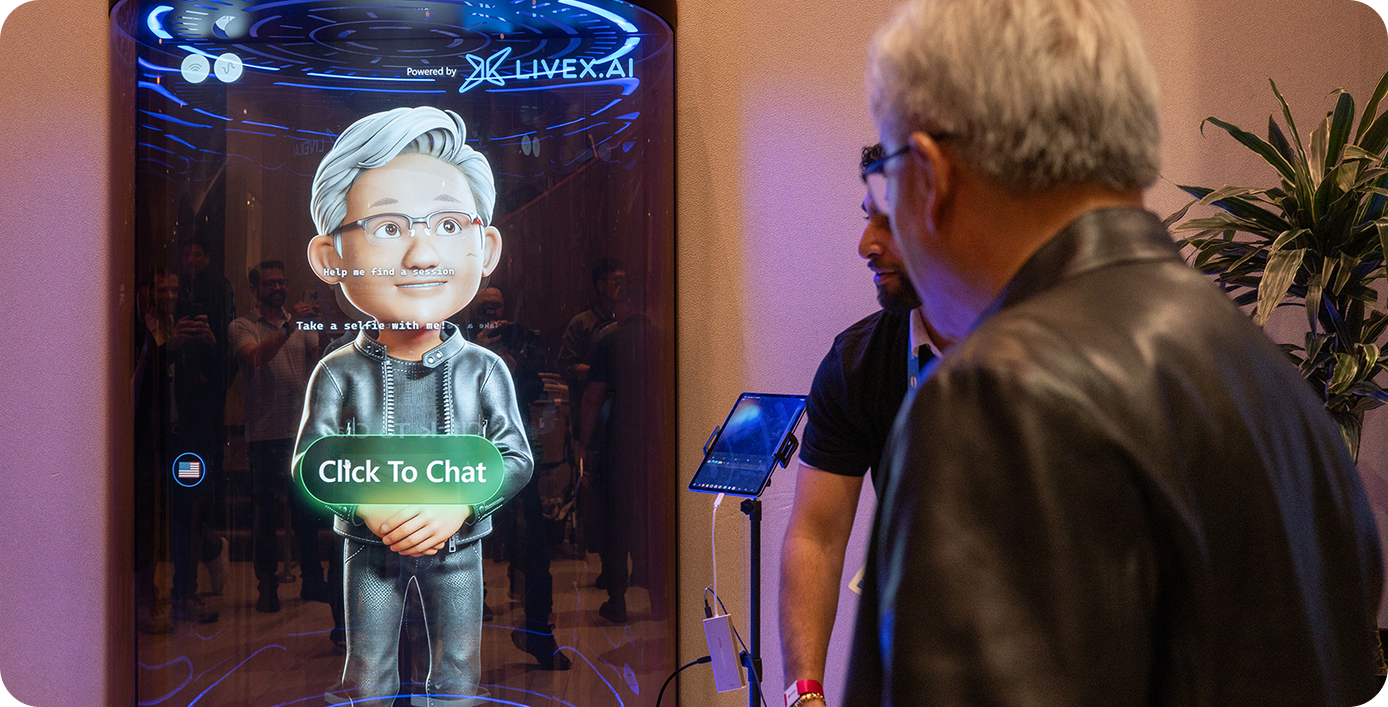
The Toy Jensen Hologram ran on LiveX AI's agentic platform, on top of NVIDIA Nemotron, NIM microservices, CUDA, TensorRT, Triton, and NeMo.
This underlying tech fueled the performance that makes LiveX’s user experience the best on the market: speech capture in a room with five thousand people, speaker isolation when two attendees talk at once, latency low enough that the response lands while the questioner is still looking at the hologram, and stability across twenty units running for three days straight.
All of this was made possible through foundational tech from NVIDIA and smart custom development from the LiveX product team.
One comment that we kept hearing from attendees that had experienced other AI holograms: “We’ve never seen a hologram operate so smoothly in a real world environment."
Most physical AI vendors solve one or two glitches while others continue to erode the experience. The visual might look correct, but speech recognition fails in loud rooms. Or speech works, but latency makes the whole exchange feel like a video call to Mars. Or one unit performs beautifully and the second one needs a babysitter.
With deployments at Dreamforce, the Super Bowl, Puma stores, downtown San Jose and now GTC, LiveX has proven over and over that its stack has the most battle tested technology of any AI hologram vendor on the market.
Each Toy Jensen hologram came equipped with LiveX's built-in selfie feature, which lets users snap a photo with the device and instantly composites their image onto a custom branded background — in this case, GTC-themed scenes featuring the cartoon Jensen alongside them. Attendees walked up, took a photo, and shared it before they'd even reached their next session.
Thousands of selfies were captured across the eighteen Toy Jensen units over three days, and the posts made with those images rippled outward on LinkedIn into thousands more impressions, comments, and reshares from people who weren't even at the conference.
What made it work was the combination of two things: the novelty of the hologram itself, and a selfie that gave attendees something concrete to post with a built-in story attached: I talked to Toy Jensen at GTC.
The result was a continuous loop of organic reach, with LiveX and NVIDIA showing up in feeds across the tech industry for days after the show floor closed.
.png)
Holograms in isolation aren't the point. The deployment model is.
A retailer with two hundred stores has the same problem GTC has: scaled-out high-traffic environments, repeated questions, multilingual visitors, limited human staff, and a brand to protect. The same is true of hotel chains, airport terminals, hospital lobbies, stadiums, and corporate campuses. These are places where a human greeter can't be everywhere and a basic touchscreen tablet feels like 2014. Physical AI sits in between: present, intelligent, on-brand, not requiring anyone to learn an interface.
The mistake we keep seeing in this category is treating physical AI as a way to generate a bit of marketing hype without actually embedding it into the core infrastructure of an event or business. A company might spend a lot of money on a single unit, run it for a day, and generate some press…but then everything gets unplugged and the impact deflates. That kind of activation tells you nothing about whether the underlying system actually works.
What LiveX AI proved at GTC is that AI holograms are not something to hide in the storage closet after a quick demo. In fact, they are critical infrastructure that can serve as the front door to your business. Twenty units, three days, a 30k+ person crowd that knows what they are looking at, and the same agent layer that retailers and hotels can deploy across hundreds of locations.
If you're evaluating physical AI for an enterprise environment, the question to ask any vendor is simple: can you show me an example of your team running more than 10 holograms at once in an integrated deployment model? Most can’t.
Talk to LiveX AI.