.png)
The Market Has Split Into Two Categories
Walk a trade show floor at a tech or retail conference and it’s likely that you will see an AI-powered hologram. A few years ago they were mostly a marketing prop: put a celebrity in a glass box, generate a press cycle, move on. That's still the extent of what most hologram vendors can do. But a smaller group of specialists have started using holograms to run actual business workflows: appointment booking, sales conversations, customer support, citizen services in public spaces.
For an enterprise buyer, that split is the whole story. There are vendors who can deliver a one-night activation, and there are vendors who can become part of how the business runs. Picking the wrong one is expensive, because the device looks identical in both cases…the difference is what the software behind it can actually do.
The rest of this guide compares LiveX AI and Proto across the four use cases where the gap between them shows up most clearly.
The difference between Proto and LiveX AI
Proto sits in the first category: they focus primarily on short-term activations with celebrity placements in environments like news studios, talk show sets, and movie premieres. The hardware is real and the activations photograph well. What they don't have is a software platform underneath capable of running enterprise workflows.
LiveX AI started from the opposite end, which is why it fits into the second category: part of long-term business operations infrastructure. Before there was a LiveX AI hologram, the company had already built and deployed an AI agent platform handling support, sales, and marketing across web chat, voice, email, and SMS for brands serving over a billion end users. The hologram is that same platform extended into a physical device — same agents, same integrations, same data layer.
If you're evaluating vendors and want to know which category a given one sits in, five questions sort it out fast:
- Can the hologram hold a real conversation, or is it playing scripted clips?
- Will the vendor put it on a live unscripted demo with you in the room?
- Can it run a workflow end to end — booking an appointment, completing a purchase — or does it hand off to a website?
- What does a custom CRM, inventory, or eCommerce integration actually involve?
- What's the largest live deployment they've run, and what did the data look like under real load?
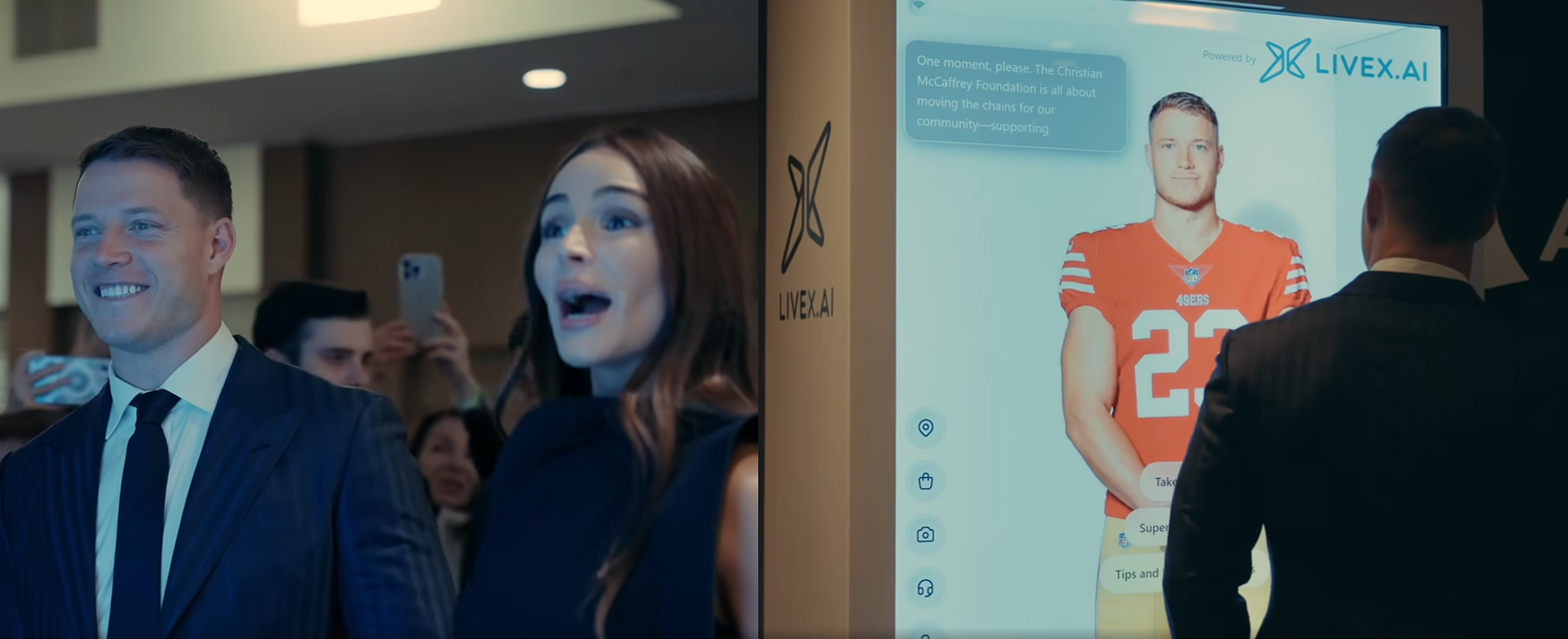
Christian Mccaffrey demos the LiveX AI Hologram unit featuring him and his charitable foundation at Super Bowl LX
Use Case 1: Marketing Activations
Holograms are good at marketing for two simple reasons. They're large and eye catching, so people stop and look. And when you put a real person inside one — a CEO, an athlete, a brand founder — the parasocial pull is stronger than any flat-screen ad.
The catch is that attention isn't conversion. Once someone walks up to the device, the system has to actually do something with them. A hologram that plays a 30-second loop is a billboard with extra steps. A hologram that has a conversation, captures a lead, and hands it back to your CRM is a marketing channel.
The cleanest way to evaluate a vendor here is to look at how big their largest live deployment was, because scale exposes everything fragile in the platform.
LiveX AI's recent activations:
- Super Bowl LX, Bay Area. 18 holograms across the region, 8 of them at the Super Bowl Fan Experience at Moscone, with 70,000+ attendees. Average engagement every 2 minutes per device. 30,455 total interactions, 14,000+ AI selfies, 1M+ social impressions. A separate unit at the Marriott Marquis Super Bowl Breakfast featured a fully interactive Christian McCaffrey accepting the 2026 Bart Starr Award.
- NVIDIA GTC. 20 devices across the conference for 30,000+ attendees. 18 of them featured Jensen Huang. NVIDIA letting an outside vendor represent its CEO across the entire venue is the kind of credibility signal you can't manufacture.
- San José Mineta International Airport. 5 holograms and kiosks featuring Mayor Matt Mahan and San Jose Sharks president Jonathan Becher, greeting travelers and answering questions about the city.
.png)
What Proto's track record looks like by comparison: Smaller activations in controlled environments — news sets, talk show stages, recent movie theater placements where an actor appears inside the device. The activations photograph well, but they don't appear to connect to any back-end systems that capture customer data or drive revenue, and live unscripted demos are rare.
Questions to ask a vendor in this category:
- How many devices have you run simultaneously at one event?
- What's the largest audience your platform has handled live?
- Can the experience switch languages and adapt to different visitor types in real time?
- What happens when 30 people are in line versus 3?
- What does the post-event data show beyond impressions — leads captured, transactions, return visits?
If the biggest reference a vendor can give you is a movie theater lobby, that's the ceiling.
Use Case 2: Direct Sales
Direct sales is the most underused application of hologram tech, and it's underused for a specific reason: most vendors can't do it. Selling through a hologram requires deep integrations with product catalogs, inventory systems, and checkout flows, and almost nobody has built those.
LiveX AI had been running AI sales agents on websites and apps for enterprise customers long before getting into hardware. The LiveX agent on Pictory's site delivered a 3x lift in conversion from free to paid. By the time the team extended that capability into a hologram, the agent platform was already running real revenue for software companies. The Puma flagship store deployment in Las Vegas is what that looks like translated into retail.
%201%20(1).png)
The Puma hologram drives sales through:
- Live product carousels tied to actual in-store inventory
- Personalized recommendations based on what the shopper asks for
- Real-time inventory and sizing checks, so it never recommends something that's out of stock
- A purchase path that connects to Puma's eCommerce backend
That last point is what separates a sales-capable hologram from a branded screen. The integrations are the product.

What a sales-capable hologram should be able to do:
- Recommend from the brand's actual catalog
- Look up inventory in real time
- Process an order and complete checkout
- Enroll a customer in a loyalty program
- Capture a lead and hand it to a sales rep
- Send a follow-up SMS or email after the interaction
Questions to ask:
- Can the hologram complete a purchase end to end, or just hand off to a URL?
- What eCommerce, inventory, and CRM systems do you integrate with out of the box?
- How long does a custom integration take?
- Can you show me a deployment that's actively driving revenue, not just impressions?
- What does your conversion data look like in pure digital channels?
A hardware-first vendor can't bolt deep sales integrations on after the fact. That work has to be done first, on something other than a hologram, before it shows up in one.
Use Case 3: Customer Experience and Support
This is where the gap between LiveX AI and Proto is widest, and the reason traces back to how each company was built.
LiveX AI was founded by three computer science PhDs, including Dr. Jia Li, formerly co-founder of Google Cloud AI. The company started as enterprise customer support software — web chat, voice, email, SMS, search — and proved the platform with major consumer brands before extending it into hardware. The hologram runs the same agent suite as the digital deployments. A customer can start a conversation in web chat and continue it with a hologram in-store without repeating themselves, because there's a single intelligence layer behind both surfaces.
Proto, as far as can be told from public materials, is a hardware company. There's no published enterprise CX platform, no AI phone or chat product, no customer case studies showing measurable resolution or deflection rates. Each Proto device operates as a standalone display.
What that gap looks like in production:
Wyze, one of the largest smart home camera companies, deployed LiveX across email, chat, app, and voice support. Self-service rate moved from 60% to 90%. Average ticket resolution dropped by 5 minutes. Cost savings hit seven figures within three months. Wyze Case-Study
Feit Electric — one of the world's biggest lightbulb manufacturers — runs LiveX across two brands (Feit and Lifx) in two regions (US and Australia). Self-service resolution averages 91.6% across digital commerce, peaking above 92% in busy weeks. AI agents run on their Shopify storefronts; an AI copilot inside Zendesk gives human agents ticket summaries and reply suggestions, and the efficiency gains compound from there. Feit Case-Study
These outcomes are possible because every LiveX agent — web, voice, hologram, email, SMS — pulls from the same underlying intelligence. For a CX team, that means:
- A customer asking the same question in any channel gets the same answer
- A conversation can move between channels without anyone repeating themselves
- Support data flows into one system, so reporting and quality improvements compound across every channel
- New channels can be added without rebuilding the knowledge base
Channels covered by the LiveX platform: voice, chat, avatar and hologram, email, SMS, QR codes, in-store kiosks, and human escalation via text, email, or notification.
.png)
Questions to ask:
- What measurable support outcomes have you delivered for enterprise clients, with named brands and verified numbers?
- Can the hologram pick up a conversation and pass it to phone, text, or email?
- How does the platform maintain context across channels?
Customer support is a software problem first. A vendor without a track record in digital CX won't deliver enterprise-grade support through a hologram, no matter how good the device looks at a trade show.
Use Case 4: Smart Cities
Cities, transit authorities, airports, and public institutions are stuck in a familiar bind: deliver more citizen services without proportionally more headcount. At the same time, mayors and downtown business associations want to drive foot traffic and tax receipts into commercial corridors. Smart-city hardware is one of the levers they have, and a few cities have started using LiveX devices for exactly that.
LiveX AI is already proving the model works in production, with named partnerships that public sector buyers can reference directly:
- A multi-device deployment across San Pedro Square in downtown San Jose, in collaboration with Mayor Matt Mahan, placing holograms throughout the outdoor shopping district including outside of restaurants and along high foot traffic thoroughfares
- A deployment at San José Mineta International Airport featuring digital versions of Mayor Mahan and San Jose Sharks President Jonathan Becher to greet travelers and answer questions about the city

These are not staged demos. They are live, outdoor, public-facing deployments operating in real foot traffic conditions. The San Pedro Square activation in particular delivers concrete outcomes a city leader can point to:
- Guides visitors to the shopping and dining experiences they are looking for
- Increases shopping velocity by reducing the time spent searching for venues
- Creates a memorable visit that encourages return trips
- Boosts revenue for downtown businesses and, by extension, city tax receipts
- Operates reliably outdoors, not in a controlled lobby environment
Each of those outcomes depends on software infrastructure that Proto and other hardware-first vendors simply do not have. Without a mature agent platform behind the device, a hologram placed in a public square is just an expensive display screen.
With the public sector stakes in mind, here are the questions that will quickly surface whether a vendor is ready for a real smart city deployment:
- Have you deployed in outdoor public environments at scale?
- How does the platform handle multilingual citizen queries?
- Can content be updated quickly when public information changes?
- What is your uptime record across distributed public locations?
- Do you have a working partnership with a municipal government we can reference?
Bottom line: Smart city deployments are won and lost on software maturity, operational reliability, and the willingness of public institutions to trust the vendor. Hardware-first companies are not positioned to win this category. LiveX AI already has.
The Decision Comes Down to Operational Fit
If the goal is one visual moment for a press cycle, a handful of vendors can deliver it. If the goal is a customer interaction layer that runs in production across venues — driving sales, resolving support tickets, holding conversations that stay coherent for more than 60 seconds — the field narrows fast. Conversational quality, integration depth, software maturity, and named enterprise outcomes are what decide it. Hardware alone doesn't.
Proto can put a celebrity in a glass box for a movie premiere. That's a real capability, and for some buyers it's the entire job. What it isn't is an enterprise customer interaction platform, because Proto isn't a software company.
LiveX built the software first, ran it in production for Wyze and Feit and others, and then put it inside a hologram. Super Bowl LX, Puma's Las Vegas flagship, Mayor Mahan's holograms across San Jose, Jensen Huang at NVIDIA GTC. Those are the deployments. Ask any other vendor for an equivalent list and see what you get back.